|

David Skillicorn comments on the efficacy of the COVID-19 contact tracing app
As COVID-19 restrictions continue to ease, the uncertainty of contracting the virus still remains. In an effort to bridge this gap, the Trudeau government will launch a smartphone app which will alert Canadians when they’ve been in contact with someone who has tested positive for COVID-19. Professor David Skillicorn has provided his thoughts on such apps.
Full story:
Dr. Sameh Sorour was awarded funding support from the OCE ENCQOR 5G Academic Technology Development Program
|
|

|
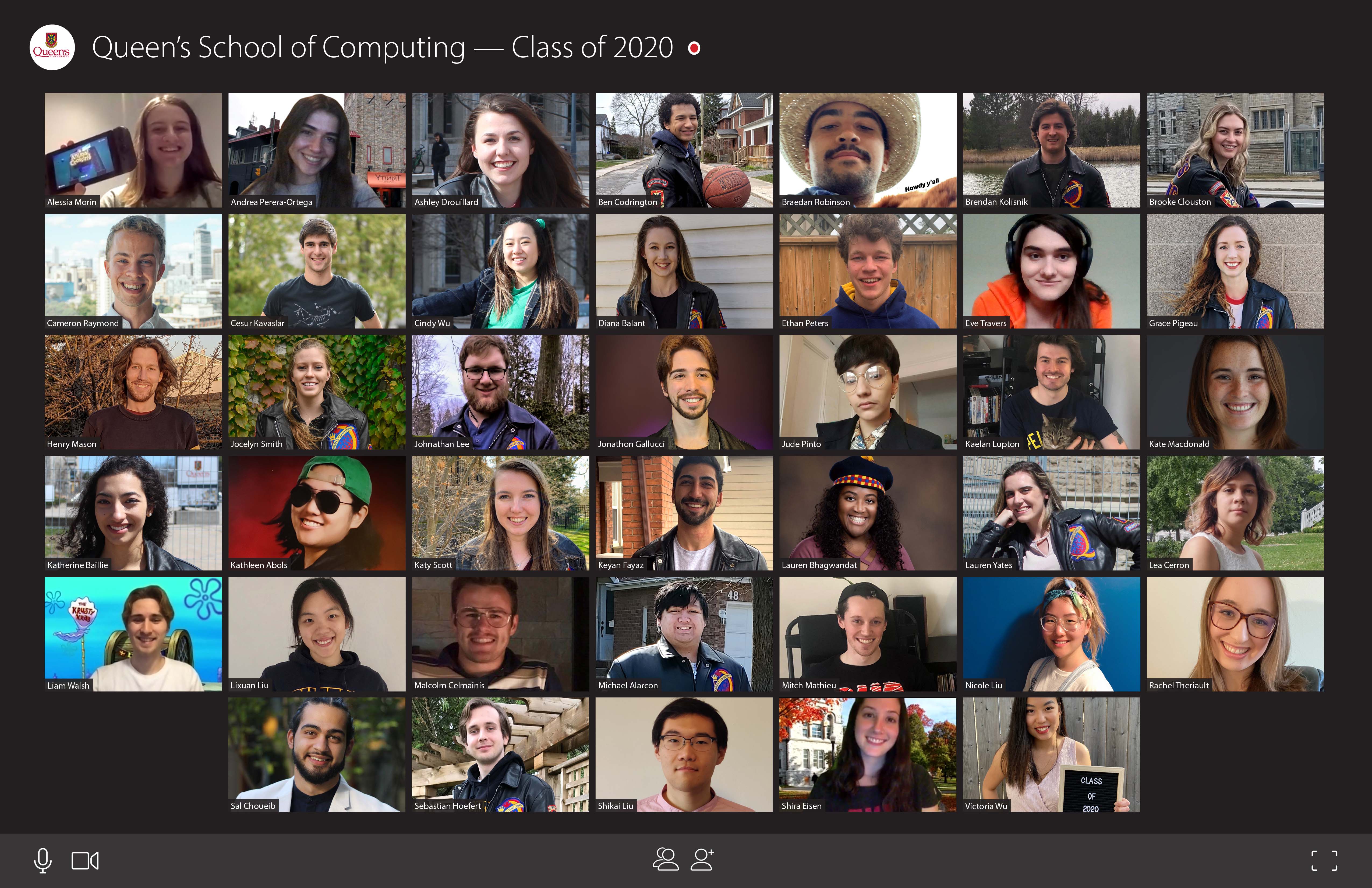
Congratulations to the Computing Class of 2020
On Monday, June 1st at 2:30 pm, our graduating class of 163 Bachelor, Master’s, and PhD in Computing students would be walking the stage in Grant Hall for their convocation ceremony. This year, due to the pandemic, we are sending off our graduates and welcoming them as our alumni remotely. We look forward to offering them a traditional ceremony in the future. Until then, watch the video message below from members of our School offering their congratulations.
A message from the Director to the Queen’s School of Computing graduating class of 2020.
Today is your day, a day to celebrate all that you have accomplished during your studies at Queen’s University. You have worked so hard over the past few years. You gained educational and life experiences, got involved in campus activities, went on internships and worked multiple jobs and managed your time and finances. Today we are so proud of all of you.
Reflecting on your time in studies
Together, we have encountered many milestones:
- We celebrated 50 years as a School.
- We developed a strategic plan focused on delivering exceptional discovery-based learning to students to ensure that they are successful computer scientists and professionals with a well-balanced educational experience.
- We attended new programs and courses that incorporated artificial intelligence, cybersecurity, biomedical informatics, and data analytics.
- We welcomed new faculty members who brought diverse research and expertise to our department.
- We studied in new collaborative labs and learning spaces.
- We overcame the obstacles of a global pandemic.
Today we recognize you as graduates and welcome you to our community of alumni. It might not be via the ceremony that we all expected when you began your studies here, but it does not change the significance of this milestone.
Welcome to our alumni network
Stay connected as the class of 2020 with the School of Computing!
- Join your Queen’s Computing Classes of 2012-2021 on LinkedIn
- Subscribe to our Alumni Newsletter
- Follow our LinkedIn, Instagram, Facebook, and/or Twitter Channels
The class of 2020 will be remembered in history as the most adaptable and selfless graduating class. You took action and demonstrated leadership by sacrificing the final days of your studies to protect your health and the health of others. As you enter a new world, we look forward to seeing how you shape, lead, and change our future.
Looking towards your futures
The skills that you carry as computer scientists are essential in times like these. You have the ability to transform industries from all sectors. The demand for your knowledge is increasing as the world reconsiders how the future will look. We are excited about the opportunities that you will encounter and will continue to support you as you pursue future endeavors.
Congratulations to the Class of 2020! Move ahead and make your mark in the world. You have already made history. Best wishes in your Computing career!!
Computing Graduates – Monday, June 1st at 2:30 pm
Doctor of Philosophy
Rahma Said Hamed Al Mahruqi, Computing, Supervisors: T.R. Dean, M. Alalfi
Nafiseh Kahani, Computing, Supervisor: J.R. Cordy
Ashiqur Rahman, Computing, Supervisor: J.R. Cordy
Alireza Sedghi, Computing, Supervisor: P. Mousavi
Master of Science
Ghazal Fouladfard, Computing, Supervisor: J.R. Cordy
Torrey William Grout Frith, Computing, Supervisor: H.S. Hassanein
Syed Akib Anwar Hridoy, Computing, Supervisor: M. Zulkernine
Susan Hwang, Computing, Supervisor: T.C.N. Graham
Madiha Kazmi, Computing
Jason Tzu-Kei Lam, Computing, Supervisor: F. Zulkernine
Lukasz Andrzej Lapczyk, Computing, Supervisor: D.B. Skillicorn
Dhanush Reddy Nandyala, Computing
Brandon Reid, Computing, Supervisor: T.C.N. Graham
Emerson Yuan-Tang Wang, Computing, Supervisor: R.E. Ellis
Bachelor of Computing
Kathleen Abols, Software Design
Tayyab Ahmad, Software Design
Michael Alarcon, Software Design
Benjamin Alderson, Software Design
Matthew Allion, Computing General
Rawan Alsaadi, Computer Science
John Anthony, Software Design
Victoria Armstrong, Cognitive Computing
Shezil Asaf, Computing General
Katherine Baillie, Biomedical Computing
Katherine Baker, Computing General
Diana Balant, Software Design
Colton Barr, Biomedical Computing
Jose Bermudez, Computing Major
Marc-Etienne Bernier, Computing General
Lauren Bhagwandat, Computing, Mathematics, and Analytics
Rajdeep Brar, Software Design
Dylan Brookes, Computing General
Michael Bryenton, Software Design
Joshua Burak, Computer Science
Noah Cabral, Computing, Mathematics, and Analytics
Sarah Carter-Anderson, Computing General
Malcolm Celmainis, Computing Major
Lea Cerron, Software Design
Sammy Chan, Software Design
Congwei Chen, Computer Science
Ke Chen, Computer Science
Chin Chen, Biomedical Computing
Tong Chen, Computer Science
Jiaao Chen, Biomedical Computing
Yuxin Cheng, Computer Science
Ik-Hyun Cho, Software Design
Saleh Choueib, Biomedical Computing
Brooke Clouston, Computing, Mathematics, and Analytics
Benjamin Codrington, Software Design
Jesse Collier, Computer Science
Timothy Crowley, Software Design
Stefan Decimelli, Computer Science
Michael Della Penna, Software Design
Matthew Dixon, Computing, Mathematics, and Analytics
Ashley Drouillard, Software Design
Eric Du, Software Design
Shira Eisen, Biomedical Computing
Brittaney Everitt, Biomedical Computing
Keyan Fayaz, Computer Science
Yiwen Feng, Computer Science
Colleen Fleury, Biomedical Computing
Jonathon Gallucci, Computer Science
Justin Gerhardt, Software Design
Christopher Gray, Software Design
Andrew Grebenisan, Computer Science
Manvir Grewal, Computer Science
Jack Guinane, Computer Science
Stephanie Harber, Software Design
Avry Harris, Software Design
Jacqueline Heaton, Biomedical Computing
Ross Hill, Software Design
Clark Hodgins, Software Design
Sebastian Hoefert, Software Design
Hanwen Hu, Software Design
Zhuo Huan, Software Design
Ian Hume, Software Design
Elliot Hume, Software Design
Jonah Isen, Biomedical Computing
Zhizi Jiang, Software Design
Yingjie Jin, Software Design
Ryan Kartavicius, Computer Science
Cesur Kavaslar, Software Design
Maxwell Keleher, Computer Science
Ryan Kirshenbaum, Computer Science
Brendan Kolisnik, Computing, Mathematics, and Analytics
Andrew Lazenka, Software Design
Sangjun Lee, Computer Science
Benjamin Lee, Computing, Mathematics, and Analytics
Johnathan Lee, Software Design
Alastair Lewis, Software Design
Yishan Li, Computer Science
Zane Little, Cognitive Computing
Shikai Liu, Computing, Mathematics, and Analytics
Xinya Liu, Software Design
Mengfan Liu, Software Design
Lixuan Liu, Computing, Mathematics, and Analytics
Chung-Ti Liu, Software Design
Nicole Liu, Computing, Mathematics, and Analytics
Mo Liu, Computing, Mathematics, and Analytics
Xiaotian Liu, Computing, Mathematics, and Analytics
Zachary Livingston, Software Design
Yuanhao Lou, Computing, Mathematics, and Analytics
Diyang Lu, Computing General
Kaelan Lupton, Computing Major
Tianbo Ma, Computer Science
Katherine Macdonald, Computing General
Tyler Mainguy, Computing, Mathematics, and Analytics
Henry Mason, Computing Major
Mitchell Mathieu, Computing Major
Noam mcgregor, Computer Science
Christopher Molloy, Computing, Mathematics, and Analytics
Alessia Morin, Biomedical Computing
Valentino Muiruri, Computing Major
Matthew Nicastro, Computing, Mathematics, and Analytics
Stephanie Noel, Computing General
Noah Peneycad, Software Design
Zheng Peng, Software Design
Andrea Perera-Ortega, Computing Major
Ethan Peters, Computing, Mathematics, and Analytics
Quentin Petraroia, Computer Science
Stephanie Pigeau, Biomedical Computing
Aidan Polese, Software Design
Matthew Pollock, Computer Science
Cameron Raymond, Computing Major
Scott Reed, Computer Science
Michael Reinhart, Software Design
Braedan Robinson, Software Design
Matthew Rodgers, Computer Science
Stefano Roque, Biomedical Computing
Katy Scott, Biomedical Computing
Tyler Searl, Software Design
Zhan Shi, Software Design
Kyusung Shim, Computer Science
Daylan Sit, Computing General
Zachary Slater, Software Design
Jocelyn Smith, Computing, Mathematics, and Analytics
Miranda Smith, Computing, Mathematics, and Analytics
Dragos Stefanov, Computer Science
Ella Stewart, Biomedical Computing
Duncan Stuart, Computing Major
Lixian Su, Computer Science
Brandon Tang, Software Design
Rachel Theriault, Biomedical Computing
Eve Travers, Software Design
Liam Walsh, Software Design
Connor Way, Software Design
Dean Wilkins-Reeves, Computer Science
Nicolas Wlodek, Cognitive Computing
Christopher Won, Software Design
Martin Woo, Cognitive Computing
Michael Wrana, Computing, Mathematics, and Analytics
Victoria Wu, Cognitive Computing
Cynthia Wu, Software Design
Fang Xie, Software Design
Hong Yi Xiong, Computing, Mathematics, and Analytics
Xue Yang, Computer Science
Lauren Yates, Biomedical Computing
Yifei Yin, Computing Major
Horace Yip, Software Design
Qianyu Zhang, Computing, Mathematics, and Analytics
Hanzhe Zhang, Software Design
Leonard Zhao, Biomedical Computing
Chuyan Zheng, Computer Science
Churan Zuo, Computing Major
Alice Santilli wins Queen’s 3MT competition
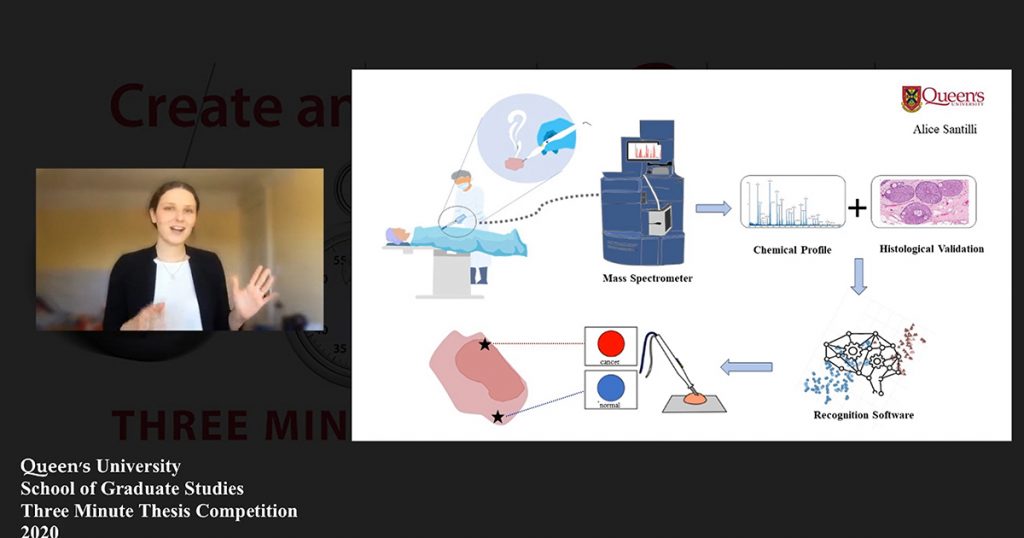
Original source Queen’s Gazette No stopping the Three Minute Thesis
Alice Santilli, a master’s candidate in the School of Computing, is the Queen’s Three Minute Thesis winner with her presentation ‘Sniffing out breast cancer.’
Every cancer patient who goes to the hospital for treatment hopes it will be their last.
Alice Santilli, a master’s candidate in the Queen’s School of Computing, wants to turn that hope into more of a reality for breast cancer patients.
“Around 40 percent of women who currently go through breast tumor removal in Canada will leave their surgery with breast cancer cells remaining in their bodies,” says Santilli, likening the process to unsuccessfully weeding a garden.
So, how do you keep the ‘weeds’ out in this case? Her research aims to create an artificial intelligence-based model that will help surgeons tell the difference between skin cells, fat cells, and tumorous cells, which would minimize the likelihood of follow-up surgeries.
Her process involves using a device called a mass spectrometer to analyze the smoke being generated by a surgical tool known as an intelligent knife, or iKnife, during the surgery. The data being fed to the surgeon in real-time would ensure the correct cells are removed.
Santilli’s exciting research and her strong presentation skills have earned her first place in the 2020 edition of the Queen’s Three Minute Thesis (3MT) competition.
Continue reading about Queen’s first virtual 3 Minute Thesis and the results at Queen’s Gazette No stopping the Three Minute Thesis
Amber Simpson receives funding from NFRF 2019 Exploration Competition
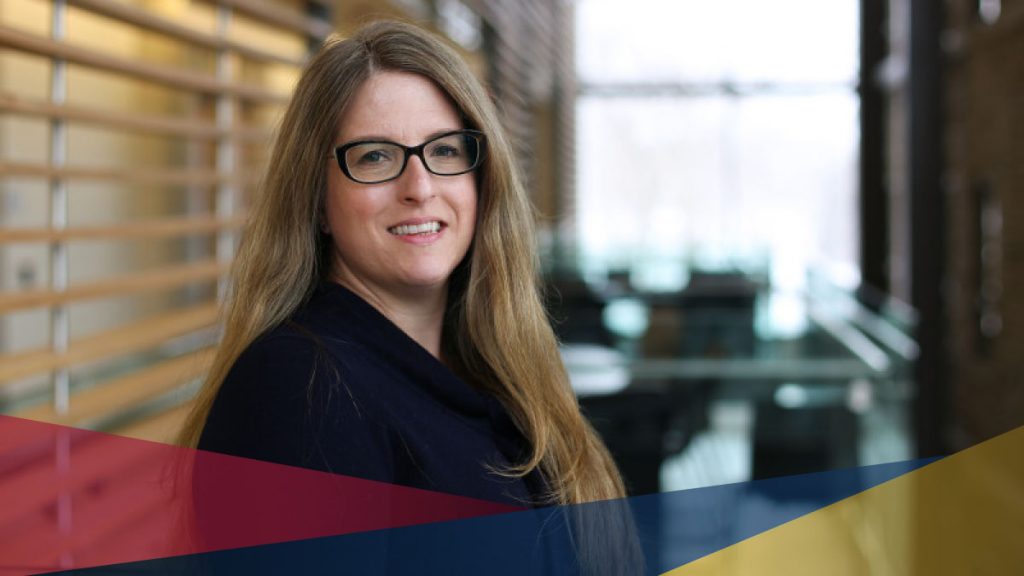
Congrats to Amber Simpson who received funding from the New Frontiers in Research Fund (NFRF) 2019 Exploration competition along with colleague Sharday Mosurinjohn. They have received $250,000 to develop a cancer digital twin from 400,000 medical images that predicts the pattern of cancer spread while considering the bioethical implications raised by the technology.
Learn more and read about all the Queen’s recipients in the Exploring New Frontiers Research Gazette story.
6 Queen’s Computing students awarded Vector Scholarship in AI
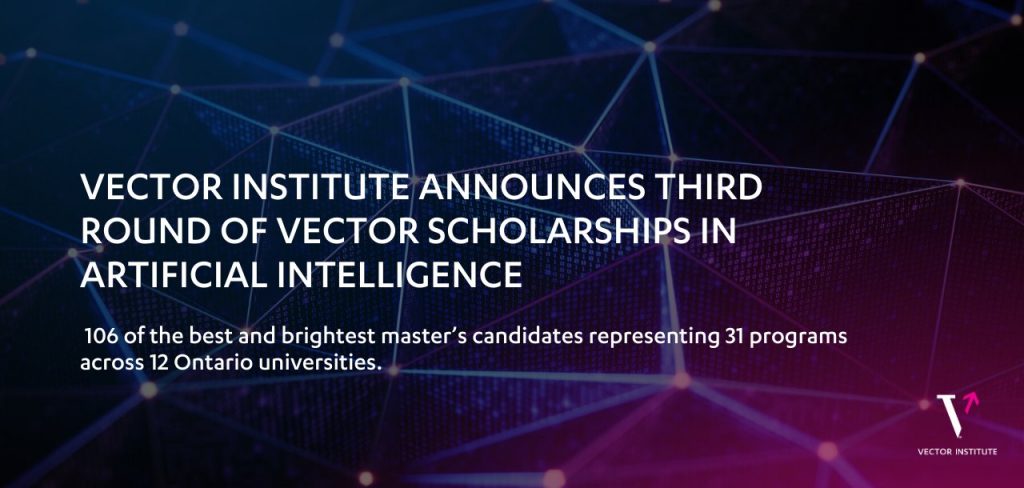
We are pleased to congratulate Queen’s University’s MSc in Computer Science students Brittaney Everitt, Duncan Stuart, Katy Scott, Minhaj Ansari, Rachel Theriault, and Zitong Su for receiving the Vector Scholarship in Artificial Intelligence.
Scholarship recipients and students enrolled in Master’s programs recognized by Vector as providing the AI skills sought by employers have unique advantages including opportunities to attend events and talks connecting students with industry, such the CIFAR/Vector Job and Data Fair, AI Master’s Summit & Career Fair, as well as priority access to workshops and other recruiting events.
Read further about the Vector Scholarship in Artificial Intelligence and the 2020-21 cohort.
Wendy Powley Receives Chancellor A. Charles Baillie Teaching Award
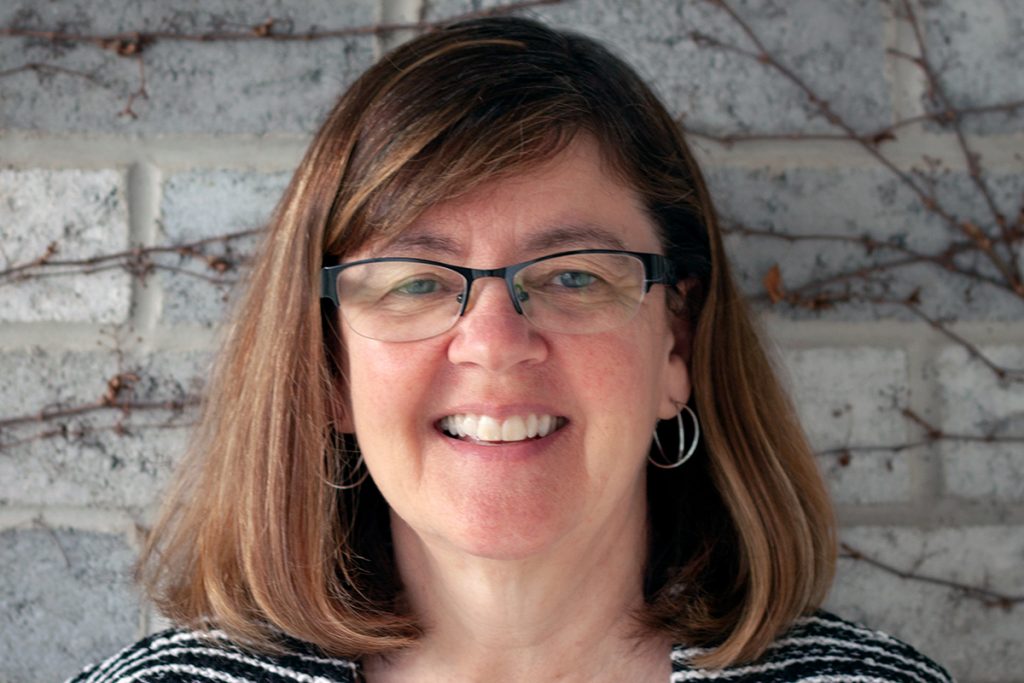
The School of Computing is happy to announce that Wendy Powley is the recipient of the Chancellor A. Charles Baillie Teaching Award 2020.
The Chancellor A. Charles Baillie Teaching Award recognizes undergraduate or graduate teaching or professional teaching that has had an outstanding influence on the quality of student learning at Queen’s University. It is awarded annually for activities that lead to improved learning, including curriculum development, educational leadership, design and delivery of out-of-classroom educational experiences, or classroom teaching and supervision.
Wendy, thanks for making the School of Computing proud!
Throughout her career Wendy Powley has had a positive impact on students and their education, from teaching a variety of courses, from introduction to programming to computer ethics in computing, to her work toward increasing the number of young women studying and pursuing careers in the technology sector.
Continue reading about what Wendy has done for women in technology and active learning in the Gazette story Impacting student futures.
Congratulations to Wendy Powley and Farhana Zulkernine on their Promotion to Associate Professor
The School of Computing would like to congratulate both Wendy Powley and Farhana Zulkernine on their recent promotion to the rank of Associate Professor. Well done to both!
James Cordy receives Lifetime Achievement Award
Congratulations professor emeritus James Cordy for being awarded the 2019 CS-Can/Info-Can Lifetime Achievement Award (LTA) in Computer Science. The award presented by CS-Can/Info-Can recognizes faculty members in Canadian Computer Science Departments/Schools/ Faculties, who have made outstanding and sustained contributions to Canadian computing throughout their careers. The award will be presented in Kingston at the CS-Can/Info-Can annual meeting hosted by the School of Computing in the Fall of 2020.
Original Source:CS-CAN INFO-CAN Lifetime Achievement Awards 2019: James R. Cordy
Throughout his distinguished career, Dr. James R. Cordy has made high-impact research contributions in programming languages, software engineering, and artificial intelligence. His work has been widely published and cited, spun off to numerous companies, and made freely available through widely used public domain tools. His contributions are unique in that he has taken fundamental results in programming language theory, demonstrated how they can be used to build practical software engineering tools, and translated these tools into industrial practice.
Dr. Cordy is Emeritus Professor and past Director of the School of Computing at Queen’s University at Kingston, and a founding member of the Software Technology Laboratory at Queen’s University. Recent academic honours include the 20-year Most Influential Paper Award at SCAM 2019, the IEEE 19th International Conference on Source Code Analysis and Manipulation, the 10-year Most Influential Paper Award at ICPC 2018, the IEEE/ACM 26th International Conference on Program Comprehension, the 10-year Most Influential Paper Award at SANER 2018, the IEEE 25th International Conference on Software Analysis, Evolution & Reengineering, the 2016 Queen’s University Prize for Excellence in Research, and the 10-year Most Influential Paper Award at CASCON 2014, the IBM 24th International Conference on Computer Science and Software Engineering.
Dr. Cordy has a long record of active service to the computing community. He is a past member and chair of several national and international awards committees, an emeritus member of IFIP Working Group 2.4, an ACM Distinguished Scientist, a Senior Member of the IEEE, an IBM Visiting Scientist and Faculty Fellow, and a registered professional engineer. He is a past member and chair of the NSERC grant selection committee in computer science, past member of the NSERC E.W.R. Steacie fellowships committee, and past member and chair of the Ontario early research awards panel. He has served on scores of program committees and editorial boards, has been invited to give more than 10 keynote addresses, has chaired over 15 ACM and IEEE international conferences, and has refereed thousands of technical papers, books and monographs. He has 43 refereed journal publications, 164 refereed conference papers published in proceedings, and 20 books/chapters.
Dr. Cordy has been active in technology transfer. He served as President and CEO of TXL Software Research Inc. (2000-2003), was the Co-founder, Vice President and Chair of Legasys Corp. (1995-2000) and Co-founder and Director of Holt Software Associates Inc. (1986-2007).
In addition to these, he has actively worked closely with companies such as Bell Northern Research, IBM Canada and General Motors to facilitate their practical use of his research results.