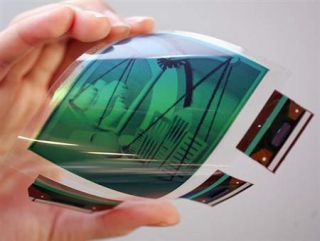
 Roel Vertegaal and the team at the Human Media Lab are working diligently to further develop the technology behind roll-up screens for devices from smart phones to tablets to large-screen TVs. The Calgary Herald reports that the technology is not quite ready for prime-time; but we’re getting closer to making fully flexible, self-illuminating screens a reality for everyday devices. Read the entire story here.
David Skillicorn Weighs in on Fed’s Anti-Spam Legislation
 If you still find your inbox inundated with unwanted messages from far away royalty offering you free money, or companies claiming they’ll send you pharmaceuticals at a fraction of their price, you were likely pleased with the federal government’s announcement of anti-spam legislation.
But the School of Computing’s David Skillicorn doesn’t think the federal government has the right plan in place for enforcing that legislation. For the complete story from the Kingston Whig Standard, click here.
Congratulations to COCA201 students
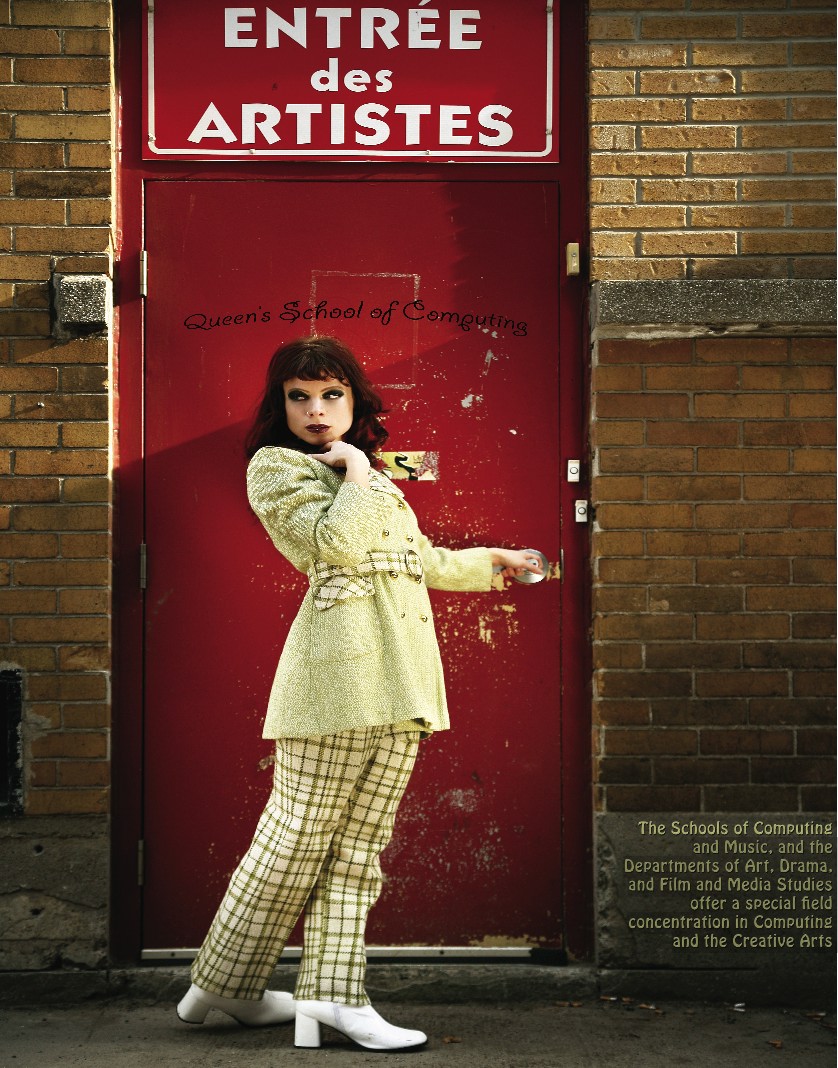 A group of undergraduate students in Computing and the Creative Arts, Andrea Nesbit, Matthew Rabinovitch, Kaja Swensen, Cameron Lapp, and Paul Strohmeier, have had their two exam works in COCA 201 accepted for the TEI 2012 arts track. TEI 2012 is the sixth international conference dedicated to presenting the latest results in tangible, embedded and embodied interaction. The five students were supervised by Audrey Girouard and Roel Vertegaal.
Hossain Shahriar Receives Best Paper Award
The School of Computing congratulates Hossain Shahriar for receiving a Best Paper Award at the 9th IEEE International Conference on Dependable, Autonomic and Secure Computing (DASC 2011).
The award was received for the paper: “A Fuzzy Logic-based Buffer Overflow Vulnerability Auditor” by Hossain Shahriar and Mohammad Zulkernine.
Human Media Lab in the News – One of the Year’s Top Tech Stories!
Congratulations to members of the QSC Human Media Lab whose work on flexible interfaces was highlighted by the CBC among the year’s top technology and science stories:
To read the entire article, click here.
Ed Koush on why a Cell Ban is not the Answer
The School of Computing’s Ed Koush was recently interviewed by the Kingston Whig Standard. He explains why the recent recommendation by the U.S. National Transportation Safety Board to ban the use of all portable electronic devices while driving, including hands-free devices such as Bluetooth, is not the answer we need. Read the full article here.
Wendy Powley Receives the Queen’s Equity Award
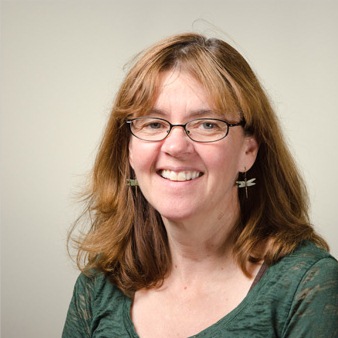 Queen’s School of Computing’s own Wendy Powley is the inaugural recipient of the Queen’s Equity Award. “Wendy Powley is a deserving first recipient of this award because her exemplary efforts have fostered a climate conducive to employment equity. Her significant contributions in the School of Computing have set a great example for the entire University,” says Gordon Smith, Chair, Queen’s Council on Employment Equity.
Wendy was nominated by over 90 of her fellow faculty, staff and students for her tireless efforts to promote the cause of women in computing – a field which is typically viewed as being geared more toward men. “Unfortunately, there exists a huge misconception regarding the nature of computing jobs and people who choose them. Once we are able to reach girls and educate them as to the opportunities that await them, they become more open minded and able to see the possibilities,” says Ms Powley. “Our efforts within the school have been highly successful; our current female enrollment numbers are 23 per cent higher than the national average.”
Ms Powley founded Women in the School of Computing (WISC) at Queen’s, an informal support, networking and social group for all women faculty, staff and students. The group has provided outreach and mentorship to young women in the Kingston community through the LEGO robotics program with the hope of educating and inspiring more girls to consider a career in computing. Ms Powley is also the founder and organizer of the annual conference Ontario Celebration of Women in Computing (ONCWIC).
Cobra: Flexible Displays for Mobile Gaming Scenarios
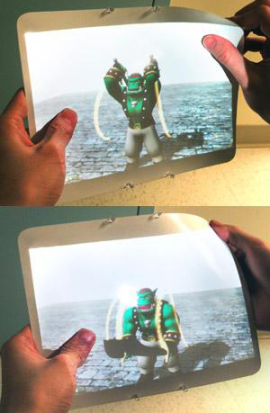 The Human Media Lab’s Zi Ye and Hammad Khalid are breaking ground for the next wave of mobile gaming. Code named “Cobra”, the system combines wearable components and flexible screens which will heighten the gamer’s experience in new and exciting ways. Read the whole story here!
Open House Friday, Dec. 9, 10AM-2PM

That’s right, save the date and make plans to attend Queen’s School of Computing’s Open House! Friday, December 9, from 10am – 2pm the School will open its doors to local and area high school students, their teachers, Queen’s students, faculty & staff and the Kingston community.
The day will be packed with information, hands-on demos and lab tours. This will be a terrific opportunity for everyone to see first-hand the exciting and ground-breaking research that is happening right here at Queen’s School of Computing, every day.
Open House Events at Goodwin Hall, 25 Union Street:
• 6th floor lobby: Reception
Join us in the lobby to begin your tour. Meet with undergraduate and graduate students, faculty, and staff from Queen’s School of Computing
• 521: Exer-Gaming with EQUIS Lab (Dr. Nick Graham)
Experience exer-gaming with demos from Dr. Nick Graham’s EQUIS Lab
• 524: Conference Room (11, noon, 1pm)
Dr. Bob Tennant, Dr. Kai Salomaa, and Debby Robertson will provide an overview of our undergraduate and graduate programs and answer any questions you may have about joining the School of Computing.
Michelle Lee will discuss our innovative internship program, experience co-op Queen’s style, Andrea Macintyre will answer any admissions questions.
• 248: Queen’s Game Developers Club, Scott Grant
This is your chance to tour our undergraduate computing labs as well as hear from Scott Grant, PhD Candidate, instructor, and President of the Queen’s Game Developers Club.
• 624: Incremental Test Case Generation for UML-RT Models, Eric Rapos (Dr. James Cordy)
Model driven development (MDD) is on the rise in software engineering and no more so than in the realm of real-time systems. We are developing prototypes to incrementally generate test cases, as opposed to regenerating a test suite every time a model is changed. This will result in an improved understanding of the impact of typical state machine evolution steps on test cases, and how this impact can be mitigated by reusing previously generated test cases.
• 627: Telecommunications Research Lab (Dr. Hossam Hassanein)
- Ed Koush, Wireless Sensors for Harsh Industrial Environments
- Ahmed Hasswa, SocioSpaces – Make Every Place Your Space
• 631: Database Systems Lab, Wendy Powley (Dr. Pat Martin)
The Database Systems Laboratory is involved in a variety of areas including Autonomic Computing, Workload Control Techniques for Database Management Systems, Cloud Computing, and Policy-based Management for complex systems such as Web Services and Database Management Systems.
• 7th floor lobby: Parallax, Jesse Burstyn (Dr. Roel Vertegaal)
Parallax is an interdimensional platforming and puzzle-solving game. The goal in each level is to reach the exit by travelling between two overlapping dimensions through rifts. Interactive objects in the level include boost pads and switches that rotate the rifts. Parallax challenges the player to think beyond the spatial boundaries of traditional platformers.
Parallax began as a project for the graduate course CISC 877 – Engineering Digital Games. Our goal was to develop a technology to allow seamless graphical rendering and physical movement through dimensional ‘rifts’.
• 7th floor lobby: TactileTape, David Holman (Dr. Roel Vertegaal)
TactileTape is a one-dimensional touch sensor that looks and behaves like regular tape. It can be constructed from everyday materials (a pencil, tin foil, and shelf liner) and senses single-touch input on curved and deformable surfaces. It is low-cost, easy to interface, and is ideally suited to rapid exploration of interfaces in early design stages. It is used as a roll of touch sensitive material from which designers cut pieces to quickly add touch sensitive strips to physical prototypes.
• Biomedical Computing Demos (Dr. Gabor Ficthinger, Dr. Parvin Mousavi)
- 6th floor lobby: PerkStation Demo, Thomas Chen, Irene Ayukawa, Mattea Welch
- 757: Tracked Ultrasound Demo Site, Csaba Pinter
- 757: Perk Tutor Demo, Laura Bartha and Simrin Nagpal
- 757: Visual Programming for Back Pain Management, Melissa Trezise
- 757: Prostate Cancer Detection, Farhad Imani
• 724: Geoff Seaborn (Dr. Selim Akl)
At the Queen’s Arrhythmia Research Centre, physicians, scientists, and students are performing promising research studies in order to provide better outcomes for patients with heart disease, and to reduce the tremendous burden heart disease places on healthcare resources. Through these collaborations of expert physicians at the Kingston General Hospital and the Hotel Dieu Hospital with Queen’s students from diverse disciplines, research results are directly translated into improved healthcare.
• 728: Dr. David Skillicorn Reverse Engineering from Language, Smart Information Management Lab
Documents and speeches provide a lot of information other than what they are (apparently) about: what the authors’ mental state was; whether they’re being deceptive; what their attitude is to the things they write about; and even their health. In the Smart Information Management Lab we study the relationship between these properties and the structure of the language that results. The focus at present is finding ways to go beyond the “bag of words” approach to find deeper structures in language that we can use to reverse engineer the relationship between what we say and write, and what’s going on inside our brains.
• 736: Andrew Dickinson (Dr. Randy Ellis)
Fusing computer-assisted techniques with surgery comes with numerous benefits, such as a significant increase in outcome success. With collaborators at Kingston General Hospital, these types of techniques have been integrated to aid in total hip replacement and hip resurfacing procedures – surgeries that a small deviation in angle or placement of a prosthetic can lead to premature failure. Come and test your “surgeon hands” on our virtual surgery model and see the future of surgery for yourself.
• 156 Barrie: SAIL Lab Demos (Dr. Ahmed Hassan)
- Identifying Performance Deviations, Mark D. Syer As large-scale software systems like World of Warcraft and the Blackberry Infrastructure need to handle increasingly more users and content, identifying performance problems has become a major priority. However, the amount of test data is too much to handle by humans, especially in the short period of time allocated for testing. We will demo a successful approach to automatically identify performance problems based on the dissimilarity of resource usage metrics.
- Effective Bug Localization, Stephen W. ThomasModern software developers are faced with hundreds of incoming bug reports each day. For each bug report, a developer must manually determine which source code file(s) to change in order to fix the bug, which is time consuming, tedious, and error prone. We will demo an effective semi-automated method for determining which file(s) need to be changed to fix a given bug. Our method uses information retrieval (IR) models to compute the textual similarity between a bug report’s description and the source code files in question.
- Mobile App Development, Israel Mojica and Weiyi ShangThe software engineering world recently has been revolutionized by the advent of mobile platforms like the iPhone/Android/Blackberry smartphones and iPad/PlayBook tablets. Mobile app development brings various unique challenges, such as scaling down features, incorporating touch screen gestures and dealing with battery consumption. To prepare students for these challenges, the SAIL lab organizes a course on Engineering of Mobile Ultra Large Scale Systems (CISC 835). Our students will demo the mobile apps they are developing for their course projects on the Android and PlayBook platforms.
Come back to this site and visit our Facebook Page for further updates on the day’s planned events!
We’re looking forward to welcoming you to Queen’s School of Computing!
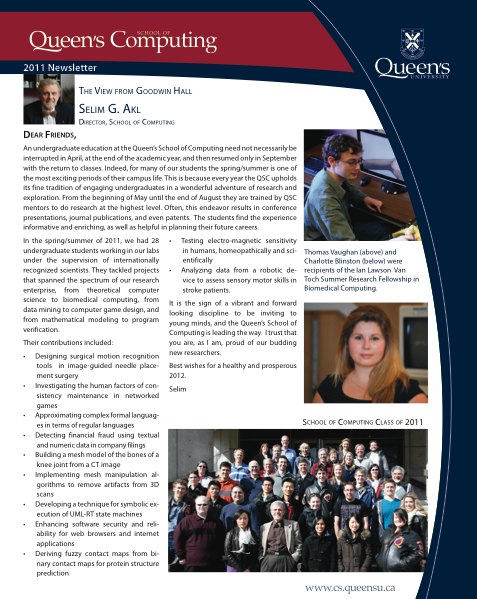
2011 Queen’s School of Computing Newsletter
The 2011 Queen’s School of Computing Newsletter is now available on-line. Once again, Lynda Moulton has done an outstanding job of curating the major events from the past year.
As a reminder, you can always read it and past newsletters at: www.cs.queensu.ca/newsletter